GlassJet wrote: how does that square with the move towards sparser collar hackles? And a sub-question(!)

is this move towards sparser collar hackles a fashion based on human foible, or a refinement due to human experience of catching fish?

andrew
Thanks, all,
Andrew,
For me it came about as a result of studying Stewart and using his spiders.
Stewart spiders are very mobile and last for a very long time before disintegrating.
The mobility is, I think, due to the space between the fibres, thus 4-5 turns, semi-palmered is less dense than four turns at the collar which clogs the appearance and action of the fibres. Thus I'd say these are sparse, whereas if the same turns were wrapped at the head it would be dense.
Other folks may have come to the same end via different routes;
or even arrived somewhere else, all good.
All I
need on my spiders is seven 'legs'; starting with 100 allows the fly to be extremely durable.
Spacing the hackle, palmer style, allows action in the water from the first cast to the last; no waiting for it to get
roughed up/thinned down into fishing mode.
In
my case, the refinements are due to the tastes of my fish.
Their preference dictates a style where the hackle is no longer than to reach the hook bend, this turns knocks into hookups, especially on the downstream swing and hang...
also shorter springy outer covert fibres are preferred (by my fish) over softer fibres as they have greater action and durability. I think that is why these attract more takes than a densely hackled fly made of softer stuff.
The body of these semi palmered flies is equally visible/obvious to the fish, more action is imparted via virtually the same amount of material - than if wrapped as a collar.
Someone, somewhere in a magazine, years ago hypothesised that the best nymph he had was double hackled; one hackle at the head, one halfway down the shank.
I believe him, did not convert to that system though; this one is faster, cheaper and simpler, and little different in use.
Teeny nymphs and Irish Shrimp flies for salmon are similar in construction.
I reckon he had no Stewart spiders in that box.
What do fish see in this style?
I reckon they see something which appears to have action from within (liveliness)
something which charicatures the natural (size,colour)
if we move it something trying to escape (action)
Our prey has amazing eyesight. Perhaps the veiling of the body makes our crude imitation attractive due to shimmering light effects.
I would place my use of this style as
refinement due to human experience of catching fish
Whatever it is, it works well.
Minimalism turns it into this
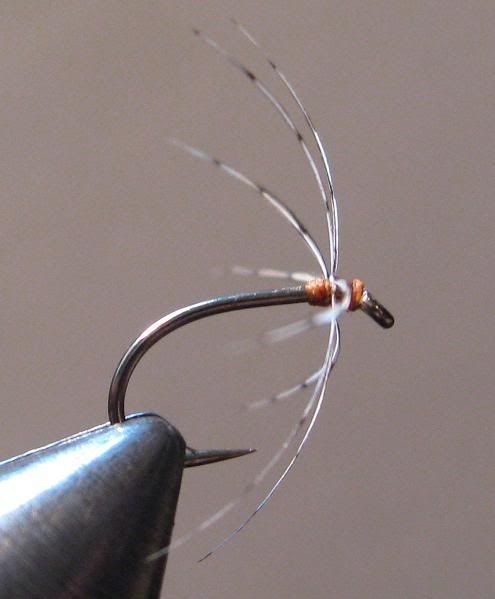
which is a low water parody.
I got interrupted while responding, by a telephone call from an expert friend, Charlie Davidson, whose very essence is north country flies.
Design - body, from eye to a point opposite the barb, one turn of soft hackle, whip finish - anything else is not true to form; just came up in general conversation
mine are all variants, two turns too short of body.

and had time to think...
we now need low water flies as there is generally much less water in our rivers here, due to excess drainage and abstraction, we are fishing smaller rivers nowadays.
enough Roy,

AND meanwhile Otter posted >>>
Stewarts Style would be at its most effective on faster water.
For spiders on slow to medium paced water - less hackle is probably best.
Then again varying degrees of hackle may be preferable for various stages of the hatch.
Stewart spiders are effective in any water, IMHO, however
in slow/medium water I'd agree, less is better.
Sometimes less is a
TINY Stewart spider for the smuts#22 - 26
rather than a less dense fly - as you allude ref: stages of hatch and matching same
All good stuff
Thanks
Roy


