Page 4 of 7
Re: Clark's Dubbing Blocks
Posted: Fri Jul 06, 2012 1:45 pm
by Ruard
Hi William,
I can do most of the times two flies on a hook 12 or 14 with one dubbingbrush. If the core is silk I have to wind up the brush when I turn it round the shank. The first of the two flies mostly has a body with some undubbed wraps. I try to make my dubbingbrushes as even as I can, but this depends also on the kind of dubbing you use and the way you turn the brush, in the air: spiky , on the block: wouly and like a rope. I don't try to make a torax in the dubbingbrush: cannot estimate where I have to make that, if I do want one than I make one with wool under the dubbingbrush.
Greeting
Re: Clark's Dubbing Blocks
Posted: Fri Jul 06, 2012 1:59 pm
by gingerdun
William,
Here are three cards of Pete Hidy bodies spun on the Clark block.
I have marked one-inch lines for size approximation.
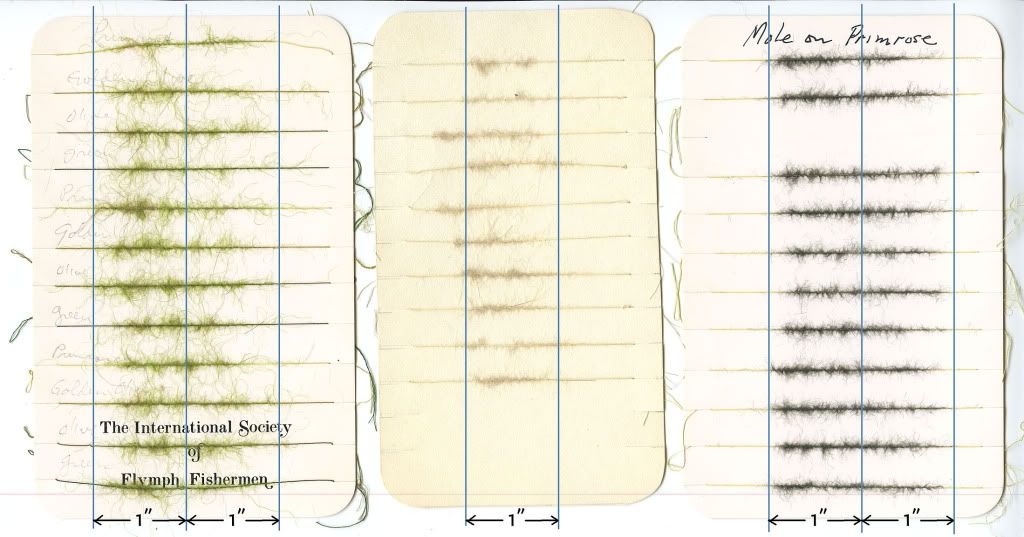
Pete tended to stay within the 12 to 16 size hook range, with a predominance of 14s.
This would translate, as you can see above, into dubbed bodies in the 1" to 2" range.
From my own experience, it doesn't take long to get a feel for how much dubbing to apply for each size hook.
I rarely have to trim off more than 1/8" or 1/4" of excess dubbed thread.
The cards in this scan are 3" and 3 3/8" wide.
Pete marked 4 half-inch measurements in pencil on his block, to help gauge the amount of fur to apply. He rarely dubbed beyond 2".
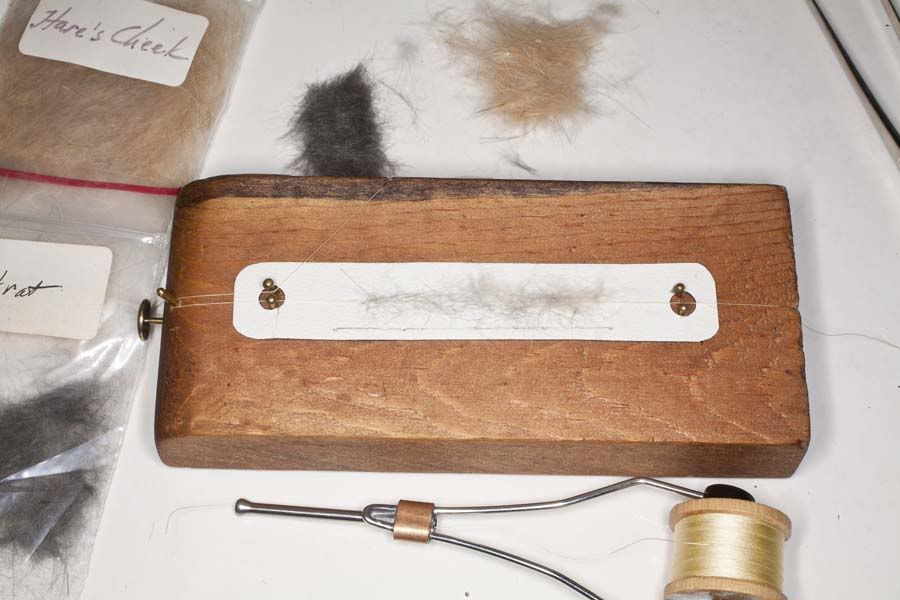
Hope this helps.
Lance
Re: Clark's Dubbing Blocks
Posted: Fri Jul 06, 2012 3:39 pm
by letumgo
Lance - I find this information especially helpful. For me, knowing the dimensions/scale helps a great deal. I struggled with this sort of thing when I was trying to replicate photos from books. The photos are often enlarged to make viewing easier, but it often leads a new tyer to overdo the size of their flies. Thank you.
William - I recently bought some Rayon thread to play with. I will give it a try to see how my results compare.
Re: Clark's Dubbing Blocks
Posted: Fri Jul 06, 2012 6:28 pm
by William Anderson
Lance, thank you for clearing that up. That's very helpful. I'm matching what I believe to be the same length that I use for the drop loop, which of course is infinitely adjustable during the tie. The loops on the block have been typically between 2-3". Seeing those 1" sections helps a lot. All of the dubbed portions on my cards now are not more than a couple inches in length, and I tie them long enough to make up the thorax, but I am going to have to tighten it up if I don't want the dubbing to be too long. I'll have to mark my block too. I should have done it when I saw Ray's marks on his. More practice.
Ray, I do like using the rayon for ribbing or twisting with herl, but having the loops unravel is a disappointment. I do like the sheen, size and translucency you get, so it has it's uses. Looking forward to seeing what you do with it.
w
Re: Clark's Dubbing Blocks
Posted: Fri Jul 06, 2012 7:40 pm
by JohnP
This is a great thread. I seriously have to make myself a dubbing block.

Re: Clark's Dubbing Blocks
Posted: Fri Jul 06, 2012 8:39 pm
by CreationBear
I was playing around tonight with another option--break up a length of Pearsall's Marabou floss into separate strands and use each strand as the core of the brush. You don't have as many color options of course, but I'm pretty sure you save a lot of bulk compared to the traditional "doubled" Pearsall's Gossamer. I'll be curious how the brushes set up overnight--it could be than the rougher texture of the Gossamer creates a firmer bond.
Re: Clark's Dubbing Blocks
Posted: Sat Jul 07, 2012 5:22 pm
by CreationBear
Addendum:
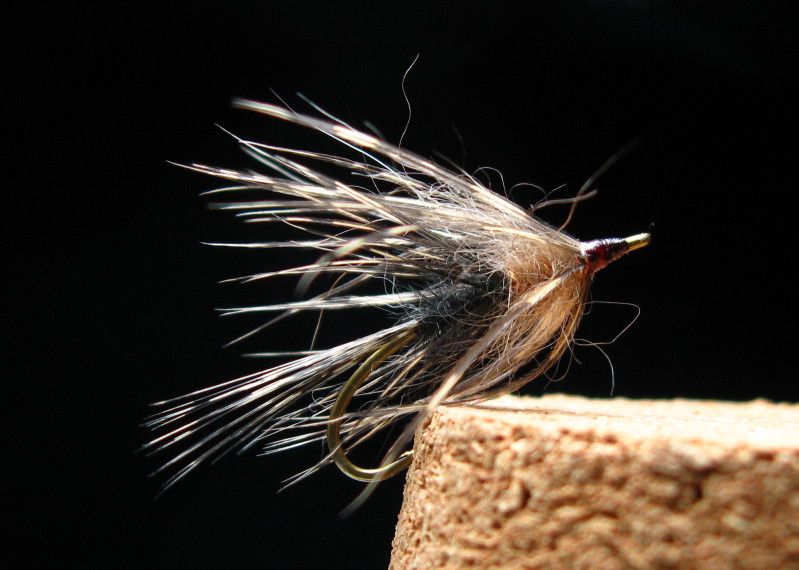
Tied up a few generic caddis emergers this afternoon using a brush made of a strand of Pearsall's Hot Orange Marabou and raccoon underfur (with a bit of claret seal thrown in). These are small (for me) #14's, so I definitely think the floss lets you tye a little smaller fly...
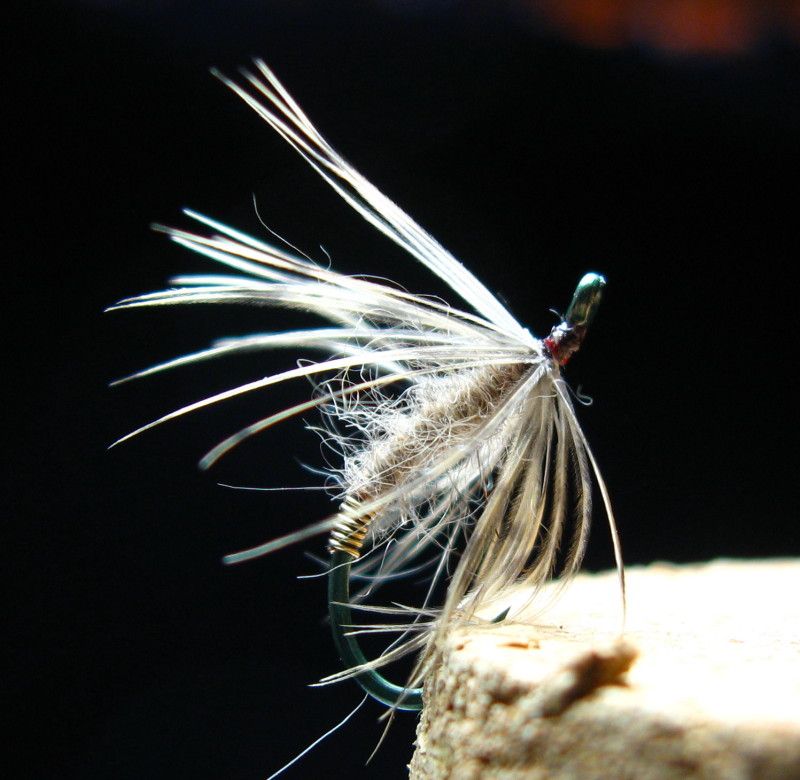
Of course, it's always tempting to play around with loops...

In this case I dropped a loop of my working thread at the rear of the hook, inserted the dubbing brush and couple of herls of peacock and wound up back to the eye:
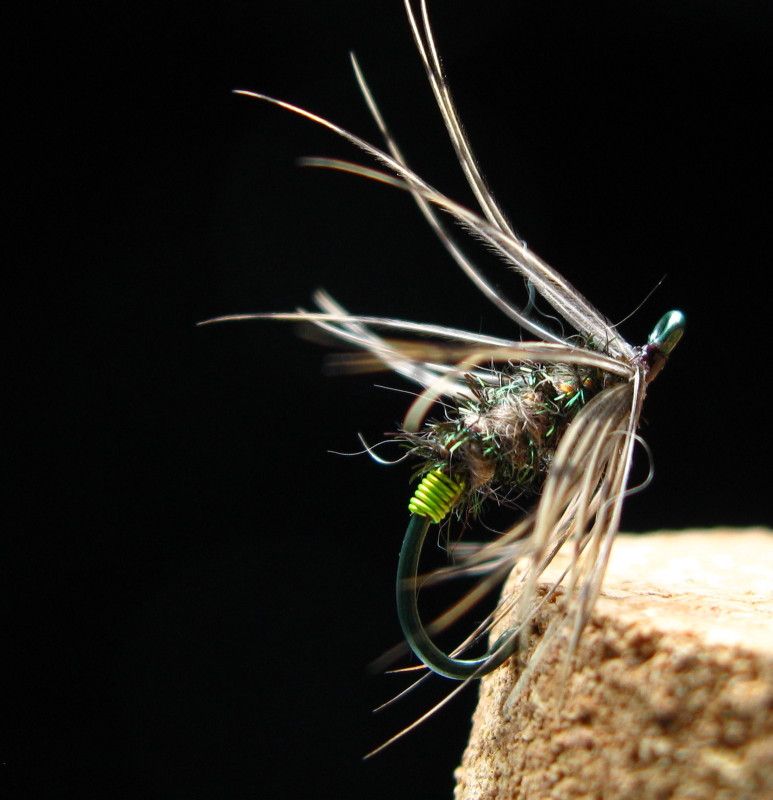
For those of y'all who like to get a bit more "anatomical," this might fish as a cased caddis--or, if you like a bit more if a subdued thorax on a mayfly flymph, the technique gives you a way of blending peacock and dubbing.
BTW, I'm digging raccon lately...on this fly, used as a wire brush thorax.
Not subdued, I suppose, but Honey Badger Don't Care:
Re: Clark's Dubbing Blocks
Posted: Sat Jul 07, 2012 7:20 pm
by gingerdun
CB,
These are so cool. Pushing the envelope, great experiments.
Lance
Re: Clark's Dubbing Blocks
Posted: Sun Jul 08, 2012 9:25 am
by CreationBear
Ha. I buy as many razor blades as I do hooks, but I blame it on the original Hidy/Leisenring flymph being such a "mature" technology--trying to improve on a Platonic form is a mug's game all around.
Re: Clark's Dubbing Blocks
Posted: Sun Jul 08, 2012 9:36 am
by hankaye
CreationBear, Howdy;
Your creations are always a treat to the fresh eyes
of the morning... Good, solid, robust with a wonderful
blend of colors and textures...
Thanks,
hank