Page 2 of 3
Re: Little Yellow Stonefly
Posted: Wed Mar 27, 2013 10:11 am
by gingerdun
Ruard, Thanks for the tying sequence. I think that is the best—although I had a little trouble hiding the cut-end of the wire up by the head. Takes finesse.
Roadkill and Creation Bear, you are absolutely right about the place here for the spiders. I have learned the hard way that this nymph construction is too bulky for anything smaller than a 12 2X-long, and even for that it is borderline. I was just intrigued by the presence of these larger size 8 to 12 stonefly nymphs in the trout streams, and thought it would be fun to explore. I also wanted to find out why Leisenring hated weighted flies so much. From what I can see, these larger nymphs tied in the round are a neglected category, while wing-case style patterns dominate. There may be a reason why these round nymphs are less popular, but I'm not sure why yet. Thanks to all for playing along with my little adventure.
Lance
Re: Little Yellow Stonefly
Posted: Wed Mar 27, 2013 11:50 am
by letumgo
Terrific post! Informative and inspiring at the same time. I am very impressed by this latest set of flies. Kudos.

Re: Little Yellow Stonefly
Posted: Wed Mar 27, 2013 2:21 pm
by Ruard
gingerdun wrote:There may be a reason why these round nymphs are less popular, but I'm not sure why yet. Thanks to all for playing along with my little adventure.
Lance
I think they did not read Brooks nor have looked into the river with a diving mask and a snorkel, Else they know that the changing colours of a turning artificial nimph frighten the fish.
greeting
Re: Little Yellow Stonefly
Posted: Wed Mar 27, 2013 2:34 pm
by Mataura mayfly
gingerdun wrote:Ruard, Thanks for the tying sequence. I think that is the best—although I had a little trouble hiding the cut-end of the wire up by the head. Takes finesse.
Roadkill and Creation Bear, you are absolutely right about the place here for the spiders. I have learned the hard way that this nymph construction is too bulky for anything smaller than a 12 2X-long, and even for that it is borderline. I was just intrigued by the presence of these larger size 8 to 12 stonefly nymphs in the trout streams, and thought it would be fun to explore. I also wanted to find out why Leisenring hated weighted flies so much. From what I can see, these larger nymphs tied in the round are a neglected category, while wing-case style patterns dominate. There may be a reason why these round nymphs are less popular, but I'm not sure why yet. Thanks to all for playing along with my little adventure.
Lance
Wingcase patterns dominate because of advances in available materials..... and the need for fly retailers to catch fishermen before fish. The most realistic modern pattern is what catches the eye of the buyer in the fly-store. Trout and insect life has not evolved that far that flies of yester-year do not catch well today, indeed in some high fished areas where trout get real picky because of the amount of artificial flies they see- especially ill presented ones, that offering something "old" in pattern but "new" to them may be just what is needed.
Re: Little Yellow Stonefly
Posted: Thu Mar 28, 2013 6:10 am
by gingerdun
Wingcase patterns dominate because of advances in available materials..... and the need for fly retailers to catch fishermen before fish. The most realistic modern pattern is what catches the eye of the buyer in the fly-store. Trout and insect life has not evolved that far that flies of yester-year do not catch well today, indeed in some high fished areas where trout get real picky because of the amount of artificial flies they see- especially ill presented ones, that offering something "old" in pattern but "new" to them may be just what is needed.
Jeff, For a lot of fly-tiers who believe in wingcase nymphs, them might be fightin' words.

I have to say that I get a little bit of a thrill when I see one that is well-designed and well-tied. With the believable wingcase and little legs sticking out on the sides. Ruard's recently-posted Little Yellow Stone is a good example. Those flies wouldn't be so popular if they didn't catch fish, right?
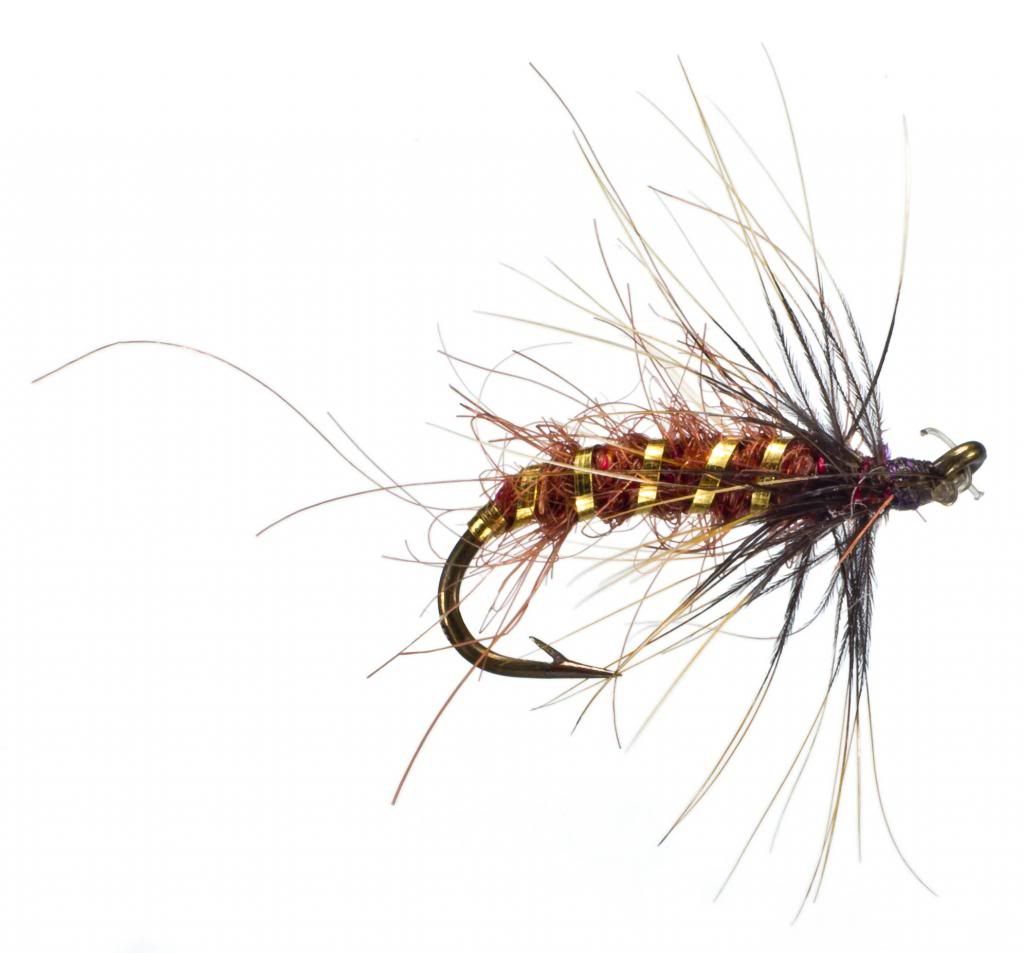
I took another look at this Mahogany Flymph tied by Pete Hidy, and realized that it could easily fish on the bottom as a little stonefly nymph. Simple tie. No tail. It is the simplicity that Pete was especially proud of, and which was part of the bond he had with Gunnar Johnson who had little use for complicated patterns that he dismissed as "fancy flymphs." I like the taper that Pete got here. The big cone-shaped head is an essential part of the pattern.
Lance
Re: Little Yellow Stonefly
Posted: Thu Mar 28, 2013 8:02 am
by tie2fish
That's beautiful, Lance. Thank you for sharing it.
Re: Little Yellow Stonefly
Posted: Thu Mar 28, 2013 2:57 pm
by Mataura mayfly
Lance, that Mahogany flymph is very nice, the rib is very "vivid" still and has not dis-coloured at all. Very striking.
I never doubted the legged and wingcased Stonefly impersonations worked, just do they work any better? Unless fished side by side or on the same team it would be hard to judge if the extra elements, time and materials added to these flies outweigh the fish taking ability of the simpler forms of pattern shown by your flymph style.
I still tie a lot of wingcased imitations, don't often use rubber legs and the like, but then our stonefly nymphs are not as big as a lot of yours and the legs can be better imitated with hackle or beards of hackle fibres.
Re: Little Yellow Stonefly
Posted: Thu Mar 28, 2013 7:39 pm
by letumgo
Lance - I love seeing this fly. It is in terrific condition after being fished. Very cool.
Re: Little Yellow Stonefly
Posted: Fri Mar 29, 2013 6:08 am
by daringduffer
Did Pete use the Turle knot on that fly? Bill Bailey mentioned that Polly Rosborough regarded an elongated head as an important feature on his stonefly nymphs. This makes sense to me. I wonder how he accomplished the mahogany colour. Do you have any notes on that?
dd
BTW - regarding the book; listen to Davie McPhail - "take your time".
Re: Little Yellow Stonefly
Posted: Sat Mar 30, 2013 6:41 am
by gingerdun
Jeff, thanks for the clarification. Whether the wingcase is an improvement over the round-tie flymph is probably one of those questions that will never be answered, nor need it be. Probably most would agree that presentation is more important than such tying details.
Ray, Hmmm, maybe it is a bad sign that it is still in good condition after being fished?
Stefan, yes, I think that is the turtle knot. For Leisenring and Pete too, the cone-shaped head was an important part of the design. It finished off the tapered shape of the body, and like the nose of a fish, helped the swimming action. Pete also thought the turned-up eye helped the flymph swim. As for the body color, that was mohair yarn off the shelf.
I went back to the card where Pete put this nymph along with seven others. He wrote "weighted" at the top of the card. That helps explain how he got that handsome taper. It is also proof that Pete did not share Leisenrings view about weight. The wire ribs on the five flies to the right have all tarnished, and don't gleam any more. Impressive how the mylar tinsel on the first three nymphs still looks new 40 years later.
