Page 2 of 3
Re: Pink & Partridge Flymph
Posted: Mon Jul 07, 2014 9:27 pm
by letumgo
Marvelous post Lance. Your Dad would have loved every detail. Kudos.


Re: Pink & Partridge Flymph
Posted: Mon Jul 14, 2014 11:03 am
by William Anderson
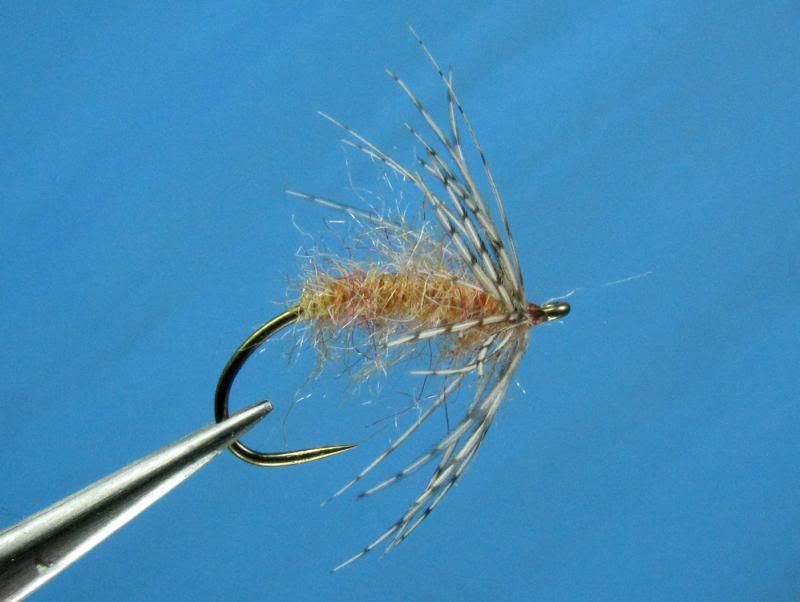
Lance, I hope you don't mind the inclusion here, but I found a fly that I photographed last year, probably tied early in my pre-spinning body days, judging from the body. Anyway, I thought I had something like this.
Great minds.
Re: Pink & Partridge Flymph
Posted: Mon Jul 14, 2014 11:41 am
by letumgo
William - Great fly. Do you remember what make/model hook this is tyed on?
Re: Pink & Partridge Flymph
Posted: Mon Jul 14, 2014 12:19 pm
by William Anderson
letumgo wrote:William - Great fly. Do you remember what make/model hook this is tyed on?
Thanks Ray. It looks like it was part of my Daiichi 1250 phase. This pattern is much lighter than Lance's, but I know I took fish on it on the Firehole with a yellow buttonhole rib. I'm looking forward to seeing some of Martin's pics from the trip (Stendalen). I know he was within view when I took a couple nice browns in a rough riffle with this pattern. I gave one to Dima at the time. I hope he fished it.
w
Re: Pink & Partridge Flymph
Posted: Mon Jul 14, 2014 4:59 pm
by gingerdun
William,
Thanks for adding this fly to the string. The experience of fishing with the bare-thread Partridge and Orange, and the same fly with dubbing added to the body, raises interesting questions. When I tried the bare-thread version on the Madison below the Hebgen Dam, I couldn't get any action. As soon as I switched to the dubbed version I started hooking fish. The water was bigger and faster than what we found on the Firehole.
The other question is about the allowable number of partridge barbs. I know that sparse is the standard. One wrap only, or two wraps if one side is stripped clear. However, I was hackling my POs heavy, one-and-a-half or two full wraps of the full feather, looking like an ignorant novice. But the fish chewed them up anyway. Maybe I would have caught more if the hackle had been sparser. But, after releasing a fish, half of the barbs were missing anyway, cut off by the trout teeth. I could usually get a second trout on that fly before the barbs completely disappeared, and sometimes a third fish. So, this experience has raised doubts in my mind about the sparse hackle dogma. The denser hackle suggests the possibility of a longer life for the fly.
The other debating point, about which I am agnostic, is tying the partridge feather in by the tip, or by the stem. I tie in by the stem since that's the way I was brung up, no other reason. And for those who tie it in by the tip, I have seen disagreement about whether to point the tip toward the eye, or toward the bend. Seems to me that all methods work, and that the choice is more a matter of style, temperament or tradition. These are the finer points that make the group fly-tying sessions so interesting. I believe this topic of tying partridge feathers to the hook has probably been beaten to death here on the FF over the years, so we don't need to go into it again (unless you want to).
Re: Pink & Partridge Flymph
Posted: Mon Jul 14, 2014 5:43 pm
by Roadkill
gingerdun,
To test the other end of the attractor fly spectrum here is a Wile E. Pink Flymph
. A #14 tied with fl. pink thread, red wire rib and body made with medium pink AL rug yarn blended with pink dyed Coyote and the Partridge hackle.
 B0092507
 by
William Lovelace, on Flickr
Re: Pink & Partridge Flymph
Posted: Mon Jul 14, 2014 6:20 pm
by letumgo
Looks like a grayling fly! I'd love to be able to test this on some...
Great fly Bill. Really well done.
Re: Pink & Partridge Flymph
Posted: Mon Jul 14, 2014 6:28 pm
by Old Hat
Some nice reading in this post.
Lance, as far as hackling goes. I normally tie in two full turns for my soft hackles. Now if tying a traditional spider then I go a bit more sparse but for my own patterns one and half or two full turns of a full feather is my standard. I'm after a certain appearance and the amount of turns really depends on the attributes of the hackle I'm using and the insect I'm mimicking. I have always doubted the effective difference between very sparse and semi-sparse hackling in most scenarios.
Also, I don't think it makes a difference how the hackle is tied in, but I do personally prefer to tie in by the lower portion of the stem. However it is tied in, I think it is very import and that the hackle is wrapped rearward and counter wrapped forward with thread.
Re: Pink & Partridge Flymph
Posted: Fri Jul 18, 2014 9:48 am
by CM_Stewart
gingerdun wrote:
The other question is about the allowable number of partridge barbs. I know that sparse is the standard. One wrap only, or two wraps if one side is stripped clear. However, I was hackling my POs heavy, one-and-a-half or two full wraps of the full feather, looking like an ignorant novice. But the fish chewed them up anyway. Maybe I would have caught more if the hackle had been sparser. But, after releasing a fish, half of the barbs were missing anyway, cut off by the trout teeth. I could usually get a second trout on that fly before the barbs completely disappeared, and sometimes a third fish. So, this experience has raised doubts in my mind about the sparse hackle dogma. The denser hackle suggests the possibility of a longer life for the fly.
"The spider is made rather more bushy than is advisable at first, as the trout's teeth would otherwise tear it away too fast. After capturing a dozen trout it will be spare enough." WC Stewart, The Practical Angler
Re: Pink & Partridge Flymph
Posted: Sat Jul 19, 2014 8:19 am
by gingerdun
Bill, that is a serious contribution to pinkness in fly tying. I like the Wile. E. coyote connection. Great-looking fly.
And Carl and Chris, your comments about how heavy to tie on the partridge are much appreciated. Makes me feel a little less embarrassed about my own flies.
That reference to WC Stewart is most helpful!