Snack time is how best to describe early summers evenings. The daytime hatches will be all but over apart from the odd straggler, spinners will be considering returning to the water but most will await the fading light, and the dusk hatches will not begin yet apart from a few false starters. Trout understand their environment and few will take up active feeding stations until the returns justify bothering. Indeed some trout may switch almost completely to dusk and first light activity. William pondered all this as he walked briskly upstream. This is a great time of the day as the fishing while difficult, William will not feel pressurised to catch anything, a few already caught and the promise of great sport later. Time to wet some new creations thought William; I will try some on the next riffle.
The approaching riffle, though smaller and similar to the last had some deeper pockets that always held trout, often a good one. As always William sat and watched for activity. Numerous trout intermittently rose in the pool below, were they onecer’s holding station and rising to an occasional morsel as their mood dictated , were some patrolling the pool and taking sustenance along their route or were they active feeders. Only way to find out was to watch and wait.
William watched and waited and quickly determined as he had expected that the pool would prove to be hard work and he did not relish hard work at this stage of the evening. This pool and riffle were well shaded and sometimes seen dusk hatches commence just slightly earlier than the first pool and riffle, if luck was on his side this would happen and he could catch a few here before heading back downstream for the main event.
William quietly got as close to the riffle as he could dare, slightly elevated beside some thorny bushes he took the small binoculars from the side pocket of his vest.
While the binoculars reduced his field of vision William had clear vision of each piece of water that he focussed on. This was all about selecting a small zone that usually fished well and watching carefully for activity. Soon a medium sized caddis emerged, struggled briefly and took flight in an instant. William tracked it as it zig zagged across the river. Soon its flying prowess increased and it headed for the sanctuary of the trees.
Several olive spinners danced above the water , a few dipping and laying their eggs , an occasional olive emerged and drifted downstream unmolested. Laying down the binoculars, William now viewed the bottom of the riffle, spotting the occasional rise, their location noted. William now turned his attention to the bushes, back with the binoculars he honed in as best as possible on the spinners and caddis, determining their type, size and coloration. Experience had taught him what to expect and generally he was correct, but it also taught him that it is a foolish angler that relies totally on past experience.
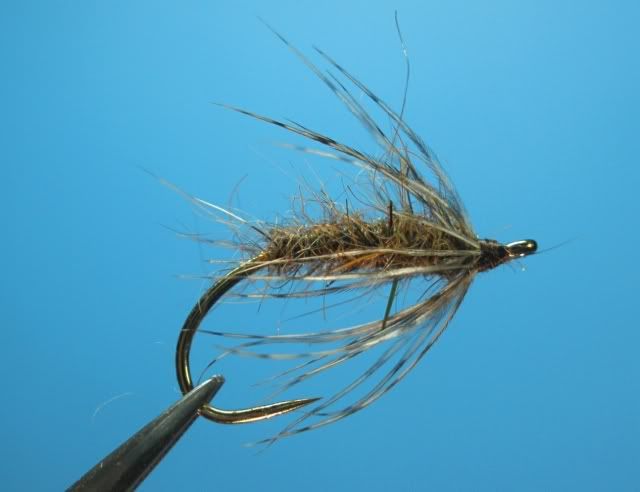
William opened the box of softies. Talking out loud to himself, “a well mixed hares ear and partridge for the point, olive thread, the hamburger of flies, always attractive to the less discerning diner, size 14 heavy wire I think”
This would be his anchor; it would determine the behaviour of the two droppers. A weighted Triple Threat olive caddis was also chosen (thank you Jim Slattery) and placed in the fly patch, ready for action if hamburgers had to be taken of the menu. Now came the big decision, the top dropper, a position when circumstances are right and the correct fly is chosen it can match and even supersede the effectiveness of the point fly
To be continued……
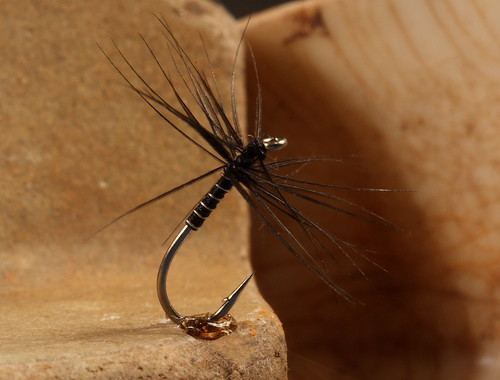
 , one hour, three minutes and fifteen seconds to work through the long section of featureless water. Same time it took to race through the earlier chores, he laughed out loud at such a ridiculous comparison. A few more trout had come to the William’s Favorite , good fishing but he did not locate a single trout that tested his abilities to breaking point. One needs a few of these each day to remind us of our own mortality and to keep our thoughts of being a fly fishing god or goddess well in check. Time to take a break from the concentration and time to casually observe, thought William. The water ahead was unwadeable and virtually unfishable. Narrowing ,deepening and darkening as it flowed through a wall of trees. William skirted around this impasse and found a nice resting spot below a short though perfect pool.


